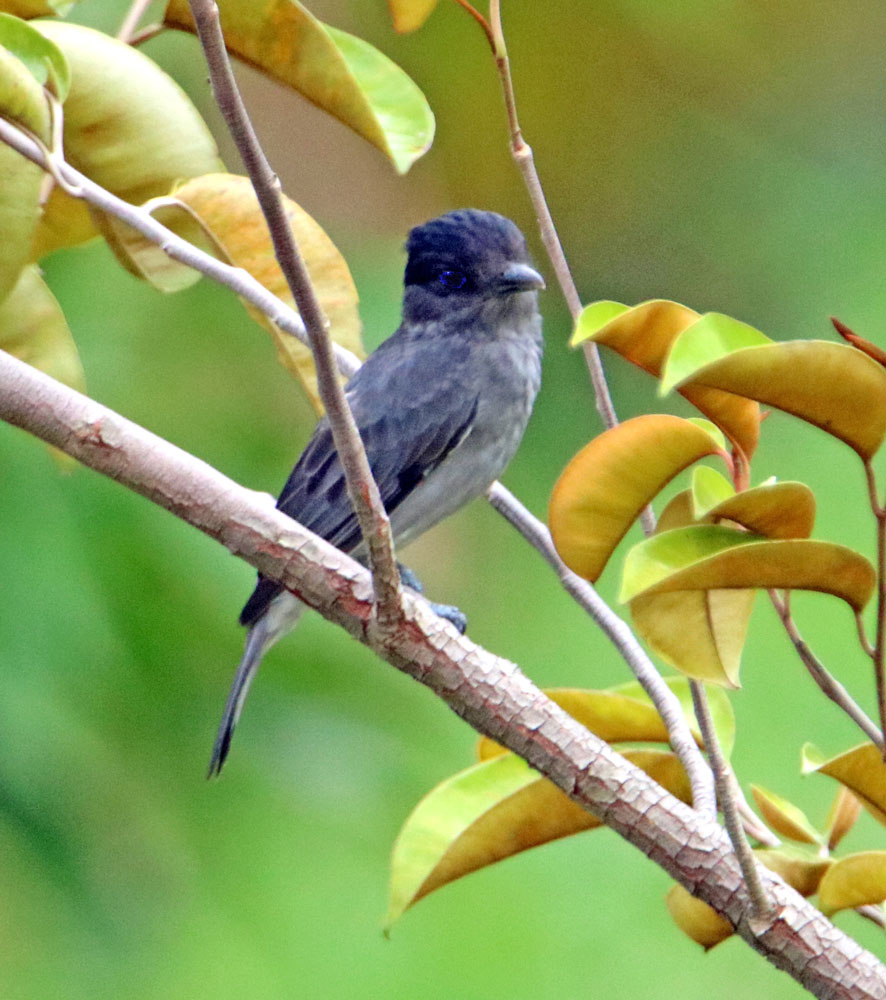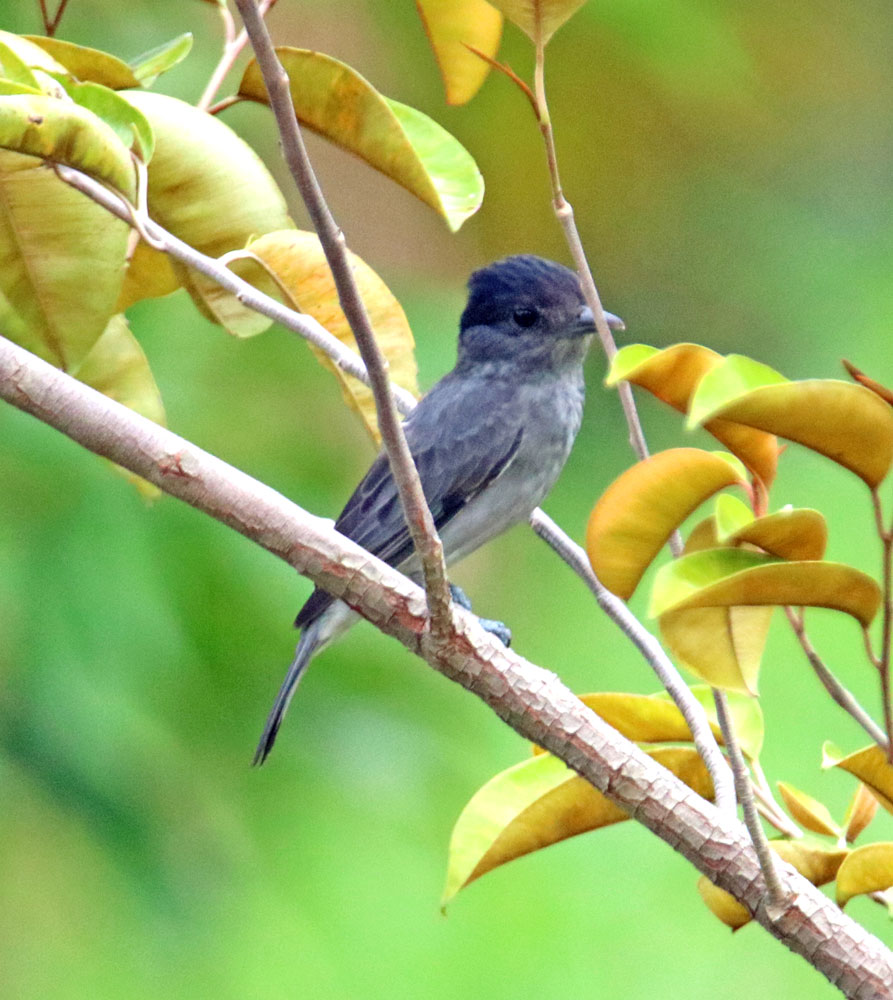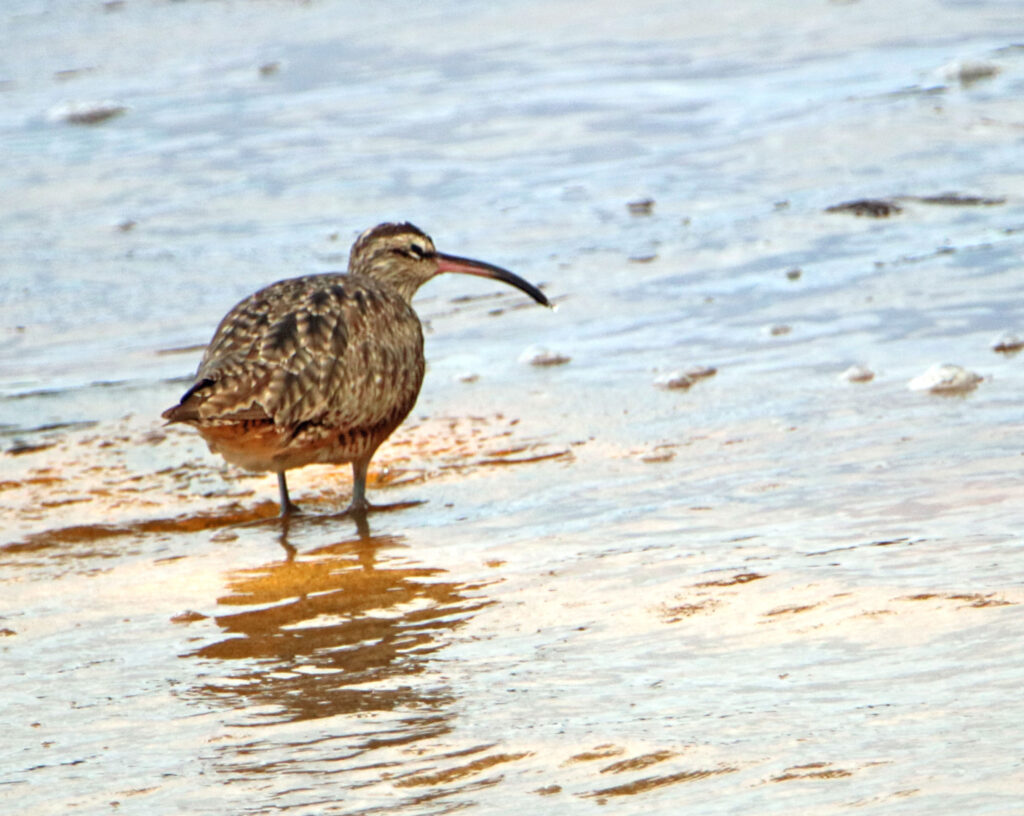

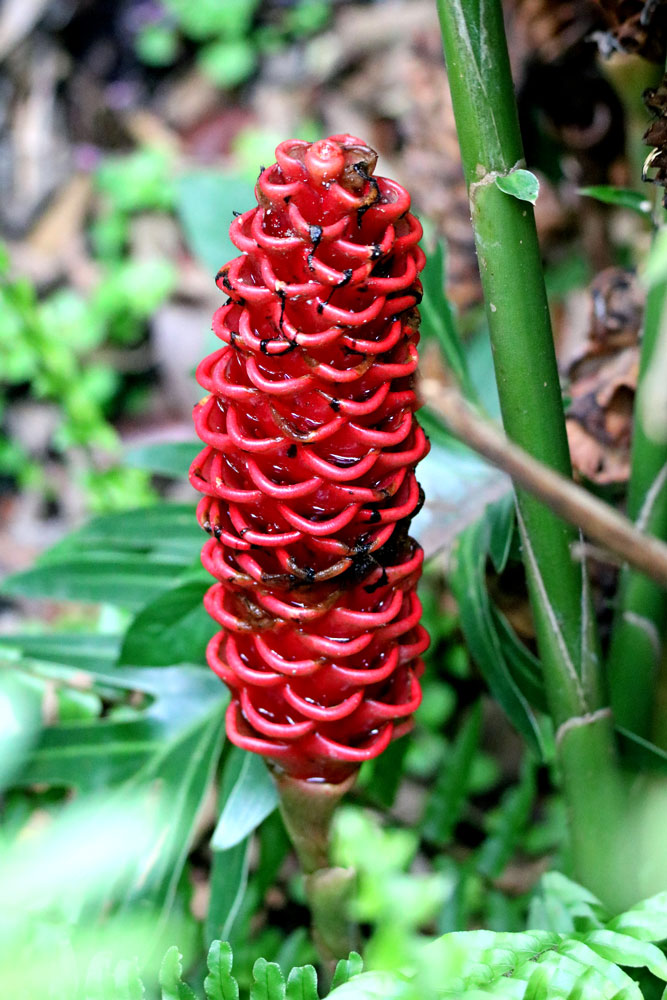
This is one of the few hummingbirds not totally chased off by the Rufous-tailed Hummingbird, though he is only an occasional visitor to my Porterweed Flowers.
Blue-vented Hummingbird, Atenas, Alajuela, Costa Rica
OOPS! The eBird Checker just told me I’m wrong on this ID and that this is actually a Turkey Vulture with no red showing and that the little yellow showing on the head is due to light and a blurry photo. Oh well, I’m leaving the original post below but moving this photo to my Turkey Vulture gallery, Plus it is interesting to note that the iNaturalist AI called this a Yellow-headed and three people on iNat agreed with that ID. So once again, IDs are difficult! (Especially with weak photos!) 🙂
A Lifer or first-time-seen bird for me! And he was in the sky above my garden! 🙂 In Costa Rica they are found only on the Pacific Slope (which I’m on), but usually more on the coast and in the marshes, says my bird book. They look a lot like the Turkey Vulture with a shorter tail and more contrasting white on outer primaries. The book also says they usually stay closer to the ground and the marshes than this one, which was flying in circles in the valley hills like a Turkey Vulture. This one has only a little yellow on his head which indicates an immature one, as they get more yellow when they age. Also, my observation was that he was flying with raised wings more than the Turkey Vulture who seems to always be gliding with flat wings stretched out. Since this is my only photo, I will not link to my gallery but rather toeBird where you can find more information and much better photos! 🙂 And the iNaturalist CR observations page and map shows where they are seen mostly, including in the marshes of the north along the Nicaragua border where I will be again in July and will look for them this time. 🙂
Lesser Yellow-headed Vulture, Atenas, Alajuela, Costa Rica
Another Anole that I am not certain about the species, but fairly confident on this ID! We will see later if the “lizard experts” on iNaturalist agree with my identification. 🙂 And note that this one is an immature or maybe juvenile. Though similar to a House Gecko, I think it is different and one of the anoles.
Copper Anole immature, Atenas, Alajuela, Costa Rica
See my other photos in the GALLERY: Copper Anole, Anolis cupreus. Or you might be interested in all my many Lizard Galleries (21+ Species) with photos from all over Costa Rica. Being in the center of the isthmus of Central America, Costa Rica has species from both the North & South American continents, giving us one of the highest concentrations of species of everything (plant & animal) of any country our size in the world! 🙂
This is one of those butterfly species, that for some reason, likes to come inside the house to die. And with the heavier than usual winds this year, inside seems to be the only place I can photograph butterflies. So here are 3 postmortem photos of a Dirce Beauty, Colobura dirce (my gallery link) on my living room floor. 🙂 And notice the big difference of the top and bottom of the wings.
The most common species of squirrel in Central America is this Variegated Squirrel, Sciurus variegatoides(my gallery link). Here’s 3 shots of a very active one in my garden who, in one photo, is gathering material for a nest. And I’m back to doing posts in real time with just a few more photos from March when I was staying 10 days ahead on posts. Hoping the winds will die down and more birds and butterflies will be visible.
Or Yigüirro in Costa Rica Spanish, as the national bird that sings in the rains every May. See more of this simple but iconic bird in my GALLERY: Clay-colored Thrush, Turdus grayi (gallery link).
It was still windy when I captured this very determined butterfly feeding on the flowers. Maybe the worse part of the January to March constant winds blowing here is no butterflies! And somewhat also my allergies to the constant dust blowing in! 🙂 But the Polydamas Swallowtail (my gallery link) seems to be one of those few tough (or strong) butterflies who can fly in the winds and is maybe the most seen butterfly during this time period. I do also see some Banded Peacocks and tiny brown Skippers in my garden, but only occasionally, plus way up in the trees are some Yellows that seem to stay high, with almost no other butterflies. But that will start changing in April & May as the winds stop and my peak of butterflies in my garden is May to September! And yes, that is the rainy season. Just one shot of this Polydamas.
Polydamas Swallowtail, Atenas, Alajuela, Costa Rica
During this very windy time of the year (Jan-Mar) there simply are not many birds on my little hill, but in February I got photos of this pair of White-winged Doves (my gallery link) in the overlapping Nance Tree & Palms adjacent my terrace that I could photograph from my outdoor rocking chair. 🙂 This species is a little larger than some and seems to handle the wind okay, but others have simply disappeared to who knows where? And of course virtually no butterflies.
Unidentified, bare-branched TREE on high banks of the stream adjacent the cow pasture in Roca Verde, Atenas, Alajuela, Costa Rica, seen here from my terrace through a telephoto lens.
“No matter how beautiful architecture men can make, they will never create such a wonderful thing as a tree.” ~Pier Luigi Nervi
I usually see this species out in the cow pasture grass, but here he is in one of my Nance Trees! See more of this seedeater species in my gallery: Yellow-faced Grassquit – Tiaris olivaceus. Just one shot from this sighting in the middle of March . . .
Yellow-faced Grassquit, Atenas, Alajuela, Costa Rica