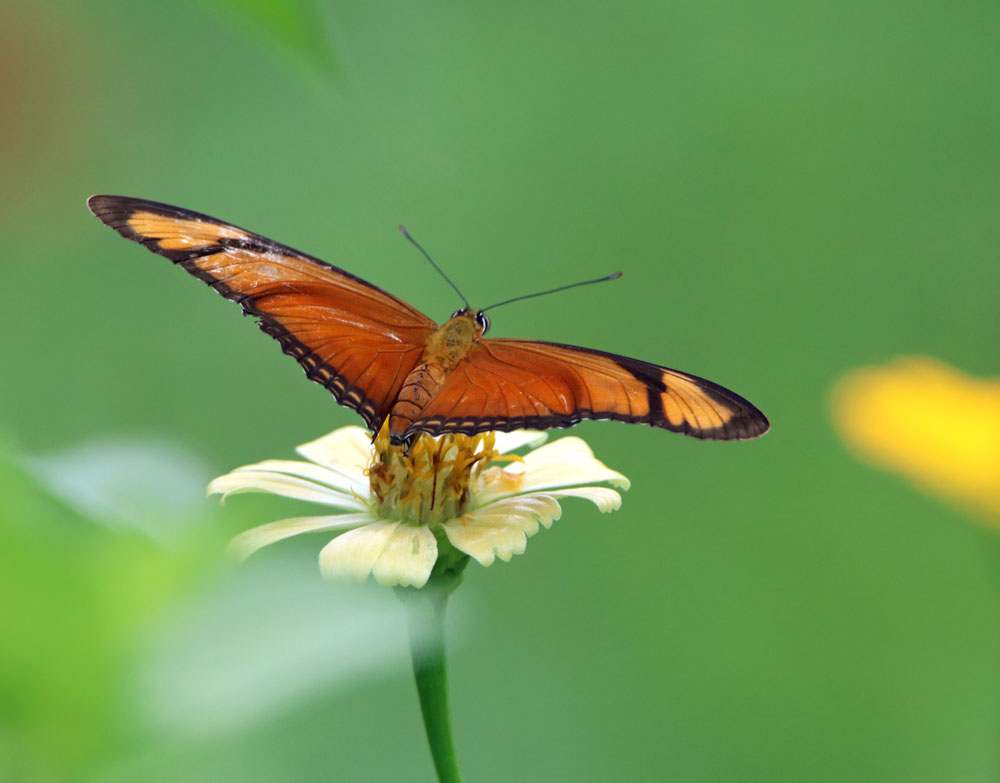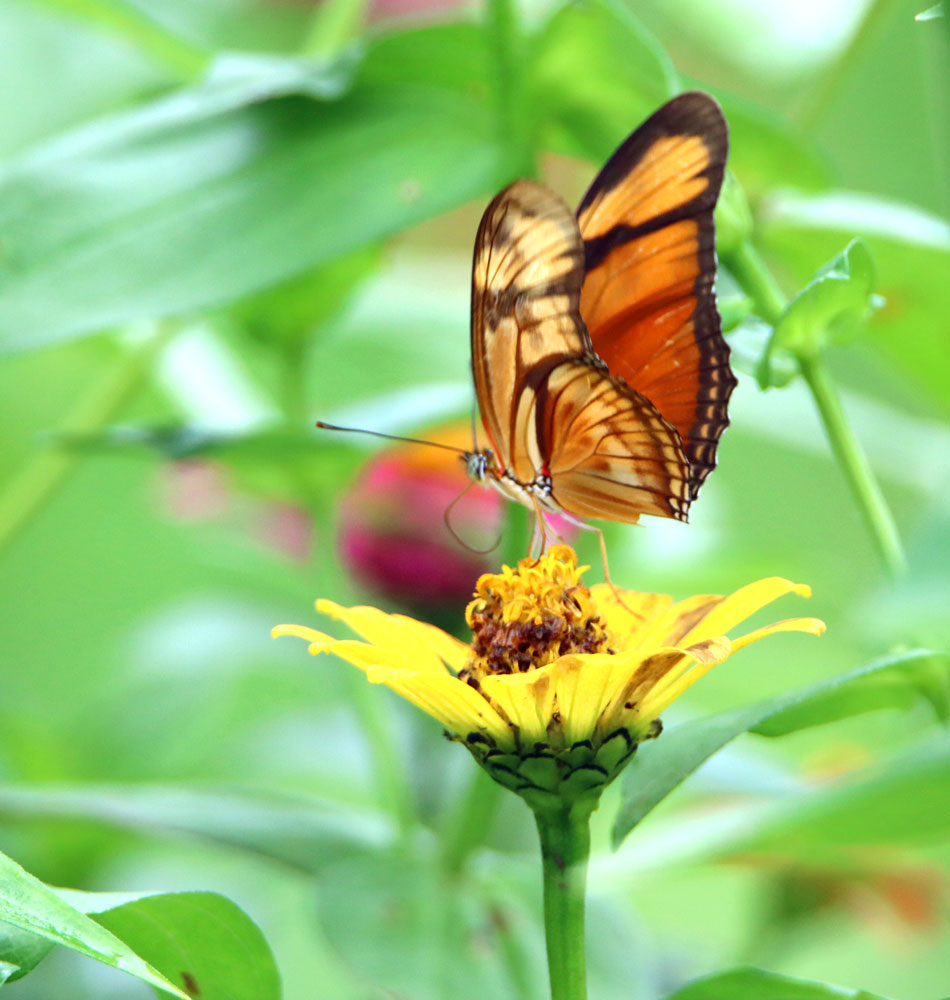

Not only is Maquenque up to 70 Treehouse Cabins (THE TREEHOUSE LODGE IN COSTA RICA!), but they continue adding wildness and nature to various corners of their deep forest. One of the additions I discovered this time is a corner of their farm alongside one of the smaller lagoons has been turned into a meadow of flowers! Not only the natural wild flowers, but they have planted more, like Zinnias, Daisies, Cuban Buttercups, Heliconia’s, and more that I haven’t identified. 🙂 And within it I photographed 15+ species of butterflies with the dominant ones being an assortment of “Tigers” or about 4 species of Genus Mechanitis (Tigerwings) and maybe a Tiger Mimic-Queen. I’m having trouble separating and identifying all the tigers! 🙂 Here’s two shots (side view & top view) of what may or may not be the same species in the “Flower Meadow,” followed by a gallery of 4 shots of the flowers in the meadow . . .
This small toucan, Collared Aracari(my gallery link) is found mostly on the Caribbean Slope of Costa Rica but it is possible to see one on the Pacific Slope occasionally where his close “cousin” the Fiery-billed Aracari(my gallery link) lives only on the Pacific Slope.
Collared Aracari, Maquenque Lodge, Costa RicaCollared Aracari, Maquenque Lodge, Costa Rica
With several tourists here from around the world, it seems that one of the first things they want to see is a toucan, and the boldest one here is this Yellow-throated Toucan (my gallery link). Here’s two slightly different views with neither showing his patch of red, but still a handsome bird! We are on the Caribbean Slope here, where this Yellow-throated is more common than the Keel-billed which is more common on the Pacific Slope. Tomorrow I will share another variety of toucans which also has a different “cousin” on the Pacific Slope.
Yellow Throated Toucan, Maquenque Lodge, Costa RicaYellow Throated Toucan, Maquenque Lodge, Costa Rica
This is the most seen hawk of all for me, almost everywhere I go. See more of my photos in the gallery Common Black Hawk. Not super good photos this trip, but this one of him flying right above me (close) is kind of interesting! 🙂
One of the coolest things we saw at Carara National Park yesterday was a Perro Zompopo · Helmeted Iguana – Corytophanes cristatus also known as the Smooth Helmeted Iguana, Helmeted Basilisk, Helmeted Lizard and a few other common names. With that Perro Zompopo being the official Spanish common name on iNaturalist and of course that 3rd Latin name is the scientific name. He was in a lot of shade behind trees, limbs and vines in the thick transitional forest of Carara, thus difficult to photograph. The above shot with a greenish hue was on my Canon Camera while my cell phone shot through the spotting scope had a duller, brownish hue. 🙂 And my identification has not yet been approved by a specialist on iNaturalist, but I’m sort of confident of this.
Perro Zompopo -Helmeted Iguana – Corytophanes cristatus in Carara National Park, Puntarenas.
We got scads of bird photos on Rio Tarcoles but it may take awhile to work through all of them, while the complicated online way of now entering national parks meant we didn’t get on trail to after 11 which is too late for birds, but our excellent guide, Andrys, found lots of other nature to experience and photograph. Both experiences were really good, though too much for one day for our age group. 🙂
I live in a tropical country, 13° above the equator, with lots of rainforests and cloud forests an hour or so from where I live. Though this Central Valley location is not as humid as a rainforest (except in the rainy season), it is still humid and I’ve learned that humidity does many negative things to my cameras and the lenses .
I recently spent over $300 at the authorized Canon Repair Shop for minor repairs and mainly cleaning of 2 cameras and 2 lenses which had various kinds of mold or other humidity-related problems affecting the electrical connections, the glass and other details.
The repair man was kind enough to reduce some of his future business by recommending that I store my cameras and lenses in a “Dry Box,” which is a metal box containing an electrical device that keeps the humidity down to the level recommended for cameras (40-50%) and at a recommended temperature of 25-29°C. And it costs a fraction of what continued cleaning and repair would cost! (just $150) So a no brainer! 🙂 When you walk in my office now, it looks like I have a little dorm fridge sitting on top of my file cabinet, full of cameras & lenses. 🙂 Anywhere one lives, there are some adaptations that can be made to live with the extremes that might be there. And this will particularly be good when I return from one of my trips to either coast or any rainforest or cloud forest where there’s always more humidity. Humidity damage is now stopped and I expect my cameras to work better! 🙂
“Helios Dry Box” or Dehumidifier for my cameras and lenses.
Under the ABOUT Menu of my website there is a PHOTOGRAPHER page with a sub-page on My Photography Equipment where I have now added this handy little device to protect my cameras and lenses. 🙂
¡Pura Vida!
This post was made about 2 weeks ago which is about how far ahead I am on creating most of my Blog Posts now since the Christmas trip to Punta Leona.
I like looking up the big hills on two sides of my little house on the side of a small hill. The other day I snapped photos through my zoom lens of two trees that I liked the looks of: First is an African Tulip Tree which I know the identity of, but the second one and my feature photo is labeled by Google LENS as a Ficus Thonningii Tree which is native to Africa, though the iNaturalist AI would not specify a species, it just said that is is probably one of the Ficus Trees or one of the Squirrel Trees. (First I’ve heard of squirrel trees!). 🙂 But anyway, I like both trees and I’m sharing these two by photos. And if both are from Africa, it is not that unusual here for people to plant trees and shrubs/flowers from other tropical continents.
This little brown skipper with a historic-sounding name was at Punta Leona Nature Resort as he sometimes is in my garden. See my gallery Pompeius Skipper – Pompeius pompeius for more photos of this “brown is beautiful” little butterfly. 🙂
Pompeius Skipper, Punta Leona Nature Resort, Puntarenas, Costa Rica
This Pale Owl-Butterfly – Caligo telamonius(my gallery link) is one of several species in the Caligo Genus with the large eye spot on each wing so that when they spread their wings they may appear to a predator as a much larger animal (like an owl) and thus a defensive mechanism. Owl-butterflies are also one of the largest butterflies in Costa Rica. This one was spotted at Hotel Punta Leona Christmas Week. Some earlier sources called it the “Yellow-fronted Owl-Butterfly.”
Pale Owl-Butterfly, Hotel Punta Leona, Puntarenas, Costa Rica